

When a newly listed coin is down 70%, I'll admit it tempts me. After a fall like that, how much lower can it go? So I counted, using four years of Bybit data. At 70% it didn't pay on average. At 80% and 90% it did.
How I tested it
I looked at every coin listed on Bybit's USDT perpetuals, including the ones that were later delisted. The period runs from January 2022 to September 2026.
The reference point is the close of the first 15-minute candle after listing. I call that 100 and go long on the first candle that closes below 30. One entry per coin, no stop loss. There are three ways out.
| Situation | Exit |
|---|---|
| Price reaches 150 of the reference | Close right away |
| Price comes back to 90 | Close 30 days later |
| Neither | Keep holding |
Fees and funding are taken out. Anything still open when the test ends is valued at the end-of-September 2026 price, so open losses count as losses. This is a backtest that assumes fills at 15-minute closes, not a record of real trades.
The average was +8.5%, but
It produced 317 trades, averaging +8.5% per entry. My first reaction was that this looked like a decent spot.
Then I took out the five best trades and ran the numbers again. The average dropped to +0.5%.
| Trades | Average per entry | |
|---|---|---|
| All | 317 | +8.5% |
| Without top 5 | 312 | +0.5% |
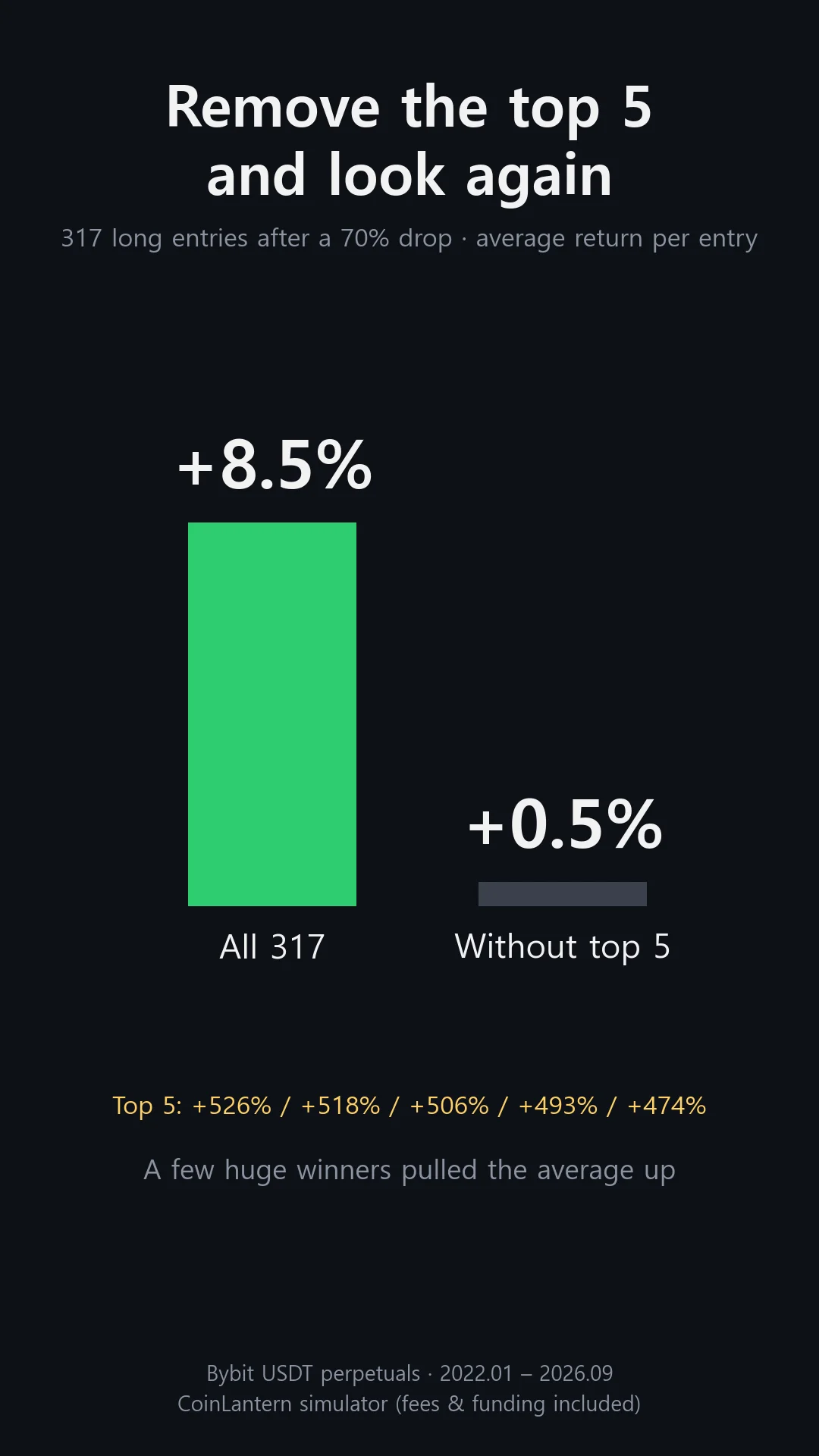
Those five made +526%, +518%, +506%, +493% and +474%. Five coins that went up five or six times were holding the whole average up.
And the rest? Only 59 of the 317 came back and closed. 228 never recovered and are still underwater, averaging -71%. They had already fallen 70% when I entered, and then lost about another 70% from there.
MELANIA is a good example. It listed on January 20, 2025, was 71% below its first candle three days later, and that's where the test went in. Within a year it had fallen another 97% from the entry price. What looked like the floor had a long way down beneath it.

At 80% and 90%
I ran the same idea at 80% and 90% drops. The exits differ slightly here: close at 100 of the reference, close 30 days after price gets back to 50, and if it never recovers, close one year after entry.
| Drop | Trades | Average per entry | Without top 5 |
|---|---|---|---|
| 70% | 317 | +8.5% | +0.5% |
| 80% | 457 | +14.5% | +7.4% |
| 90% | 295 | +28.3% | +11.4% |

At 80% and 90%, there was still a profit after removing the five best trades. These spots made money on average, not just thanks to a couple of lucky winners.
They're still not comfortable. 65% of the 80% entries and 64% of the 90% entries ended in a loss, so you lose close to two times out of three. In the 90% test, only 22 of 295 trades came back, and those few big gains covered everything else.
What I took away
The biggest lesson is not to trust an average return on its own. In crypto, a few trades can gain several hundred percent and inflate the average with them. If I had stopped at +8.5%, I'd have believed 70% was a good spot. Now the first thing I check is whether the number survives without the top few trades.
"It's fallen this far, it must be the bottom" didn't hold up either. 70% felt like plenty, and most of those coins kept falling.
Even the 80–90% spots don't win often. Most entries lose, and a handful of big moves carry the total. To catch those, you have to hold for a long time without a stop and spread your entries across many coins rather than one or two.
Things to keep in mind
The 70% test and the 80–90% tests use different exit rules, so this isn't a perfectly equal comparison. The 70% version holds losers indefinitely, which keeps losing coins in the book longer.
On October 10, 2025, the whole market crashed and a lot of entries landed on that day. Trades that haven't played out yet are valued at the end-of-September price, so these numbers can still change.
Coins that have fallen this hard are often thinly traded, too. Real fills could come in at worse prices than the test assumes.
Nothing here is investment advice. Crypto is volatile, and past results don't guarantee future returns.