

New coin listings have a reputation for multiplying in their first few weeks. I believed that too. So I went through every coin listed on Bybit futures from January 2022 to August 2026, 703 of them, and looked at what each one did in its first month.
120 coins more than doubled at some point within the month. That's about one in six. Over the same window, 250 coins fell by half or more, twice as many. And after 30 days, only three in ten were still above their listing price.
Why I counted
You hear a lot about coins that went 5x or 10x right after listing. But those stories only come from the winners. I wanted to see the ratio once the quiet losers were included too. Counting seemed easier than arguing from gut feeling.
How I counted
This is a count of price moves, not a trading backtest, so fees and funding don't come into it.
- Universe: 703 coins listed on Bybit USDT perpetual futures between January 2022 and August 2026, delisted ones included
- Listing price: the close of the first 15-minute candle
- One month: 30 days after listing. Highs and lows are measured on 15-minute closes too
- Excluded: 147 stock, ETF, commodity and FX futures
That last line is something I missed at first. Bybit listed 260 stock and ETF-style futures in 2026, and 147 of them had slipped into my list. My first count used 850 symbols. A stock doesn't triple or halve just because it got a futures listing, so I took them out and recounted with the 703 crypto coins only.
Big multiples were rare
Even reaching 2x was a one-in-six event, and the numbers thinned out fast from there.
| Highest price within a month | Coins | Share of 703 |
|---|---|---|
| 2x or more | 120 | 17% |
| 3x or more | 56 | 8% |
| 5x or more | 18 | 2.6% |
| 10x or more | 3 | 0.4% |
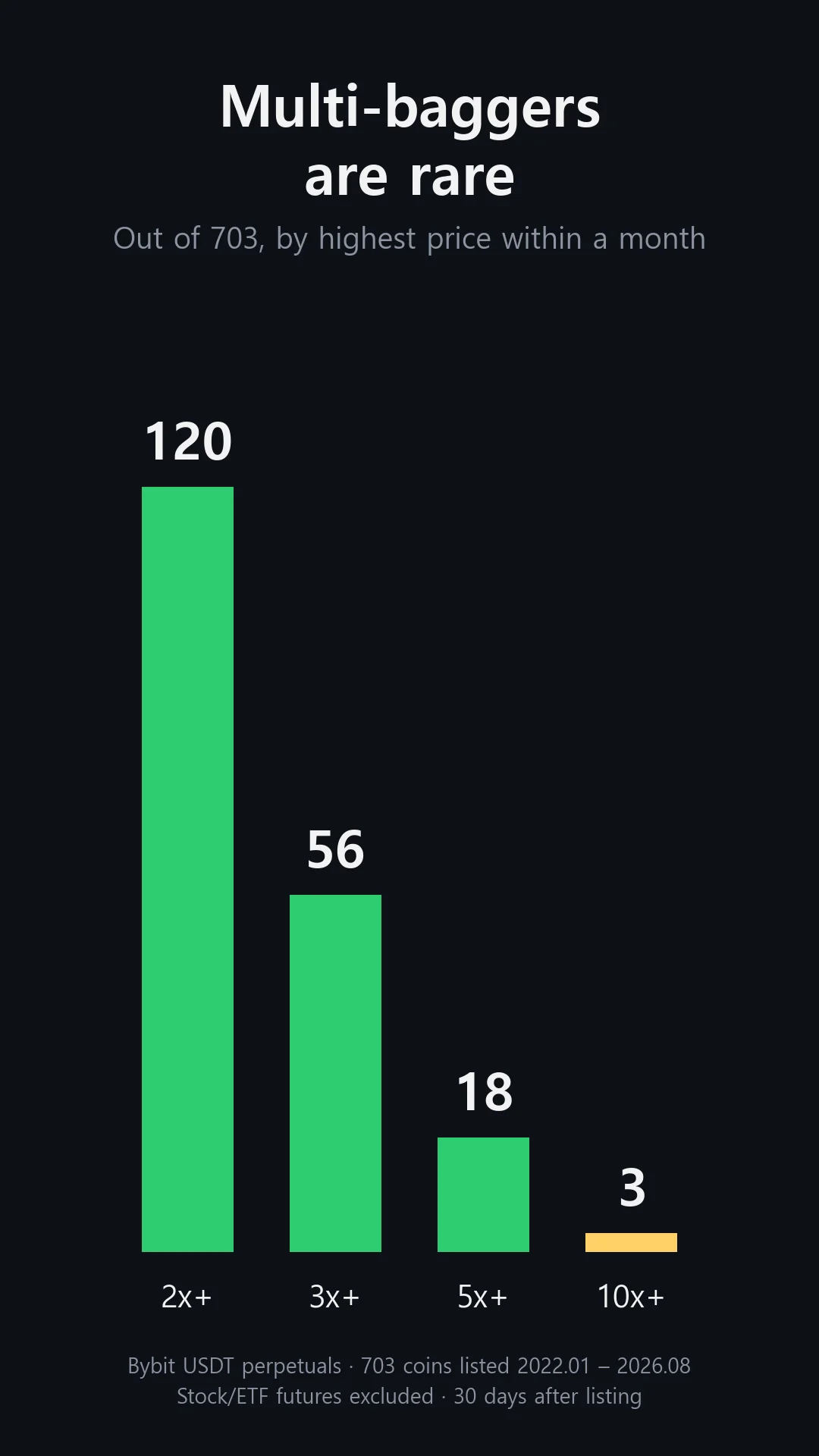
The three that passed 10x were COAI (listed October 2025, peaked around 51x within the month), UNFI (May 2022, about 12x) and AVNT (September 2025, about 10x). On the other side, 319 of the 703, close to half, never got even 20% above their listing price during that month.
The coins that hit 2x mostly didn't stay there. Of the 120, only 36 were still above 2x at the end of the month, and 21 had dropped back below their listing price.
Many more went the other way
250 coins halved at some point in their first month. That's about one in three, and twice the number that doubled.
| Lowest price within a month | Coins |
|---|---|
| -50% or worse | 250 |
| -70% or worse | 81 |
| -80% or worse | 36 |
| -90% or worse | 5 |
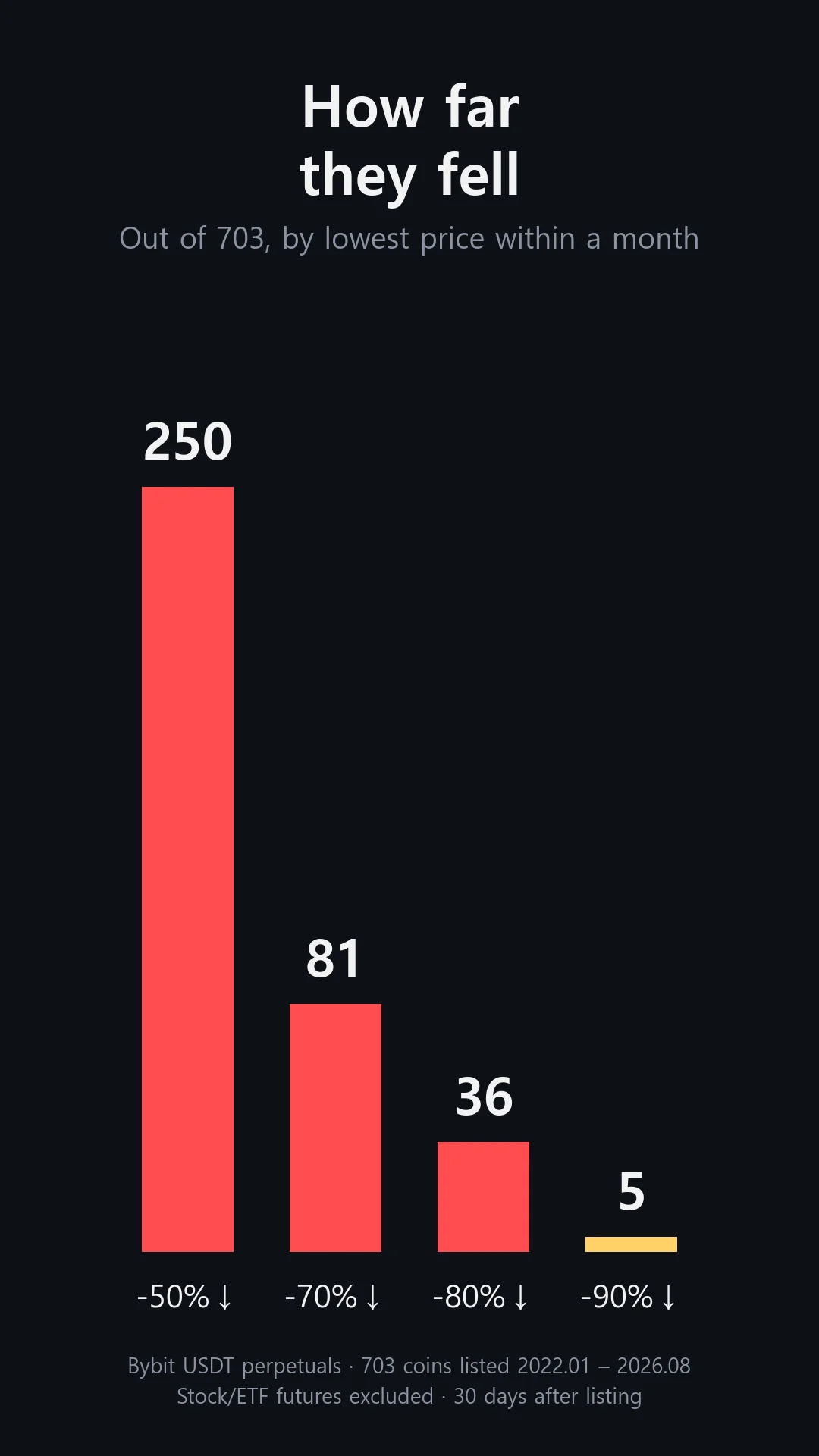
The deepest fall was JELLYJELLY, down 98% from its listing price within the month. JAILSTOOL and TMX each hit -92%. The drops also came early. 376 coins, more than half, were already down over 20% within their first week.
Only 12 coins both doubled and halved in the same month. The big winners and the big losers were mostly different coins.
Most ended the month below listing price
Comparing the day-30 price with the listing price makes the gap clearer. 203 coins were above it and 500 were below.

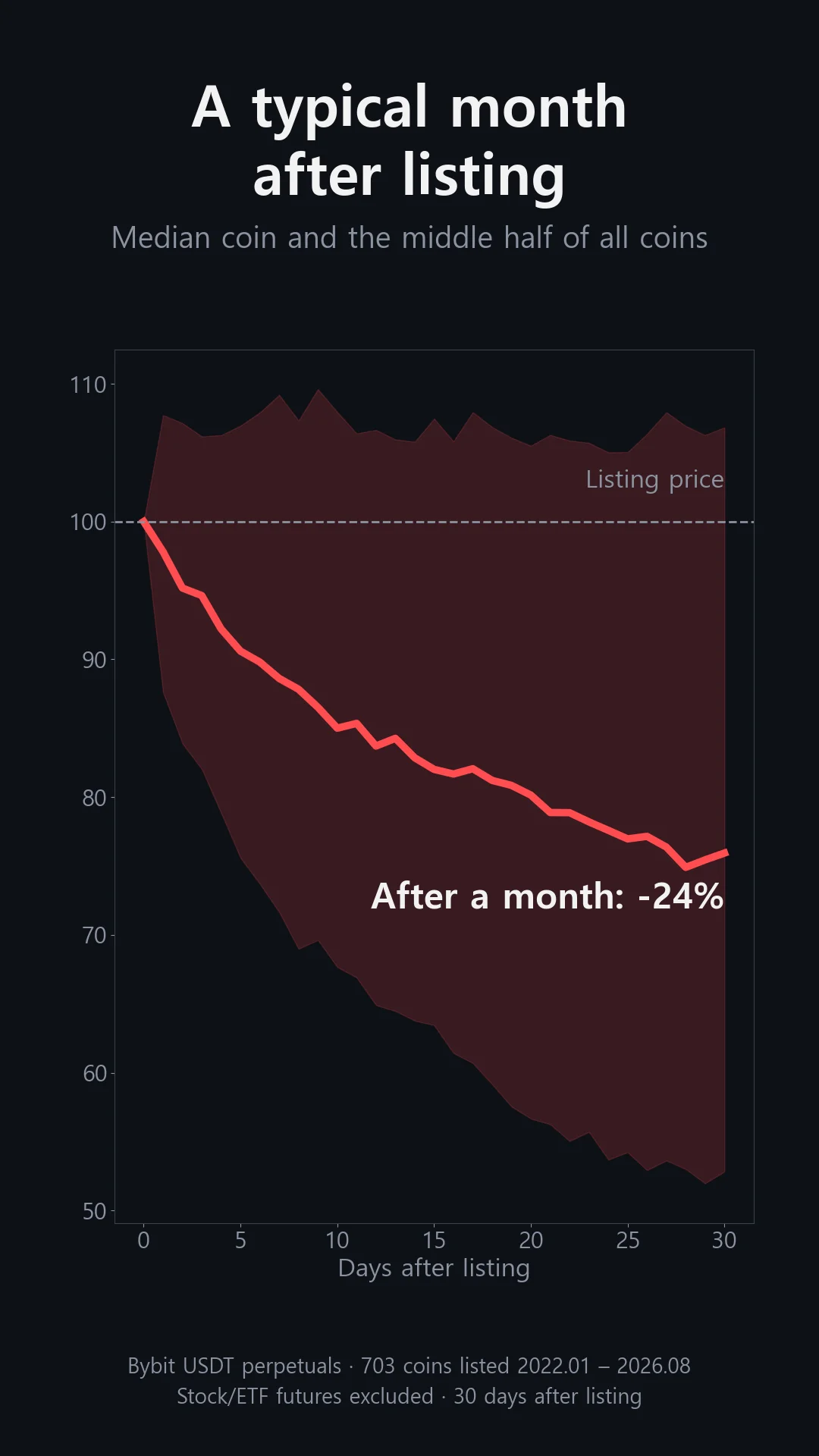
If you follow the coin in the middle, the picture is even simpler. The median coin slid down almost every day from listing and was 24% below its listing price on day 30. The shaded band in the chart below covers the middle half of all coins. Even the top edge of that band never got more than 10% above the listing price at any point in the 30 days.
What I took from it
My impression of new listings had been built from a handful of winners. With all 703 in front of me, the typical new coin just drifted lower through its first month.
The big winners are real, though. One coin really did go 51x. So the question becomes when to enter and which coins. Entering any coin right at listing would, on these numbers, have landed you on a falling one more often than a rising one.
Caveats
These are futures (perpetual) listings. The first moments of a spot listing can look different. On futures the first 15-minute candle barely moves; not one of these coins jumped more than 50% on its first candle.
Coins listed in August 2026 needed September data to complete their 30 days. Two of the 703 didn't have a full month of candles, so they're left out of the median chart only.
All of this is counted from past prices. Actually trading it would add fees, funding and slippage.
Nothing here is investment advice. Crypto is volatile, and past results don't guarantee future returns.