

I've been a software developer for more than ten years, and since June I've been building a crypto auto-trading program with AI. Was it easy? Half of it was. The buy-and-sell part comes together in minutes. Keeping it running 24 hours a day with real money turned out to be a different job entirely. Over four months I wrote and rewrote roughly 100,000 lines of Python, and I'm still in the loop of building, fixing and testing. This is what actually happened along the way, with the numbers.
The trading part is 15 lines
Tell an AI "buy when it drops 5%, sell when it rises 10%" and you get something like the code below. It connects to the exchange, checks the Bitcoin price every minute, and places an order when the condition is met. Fifteen lines.
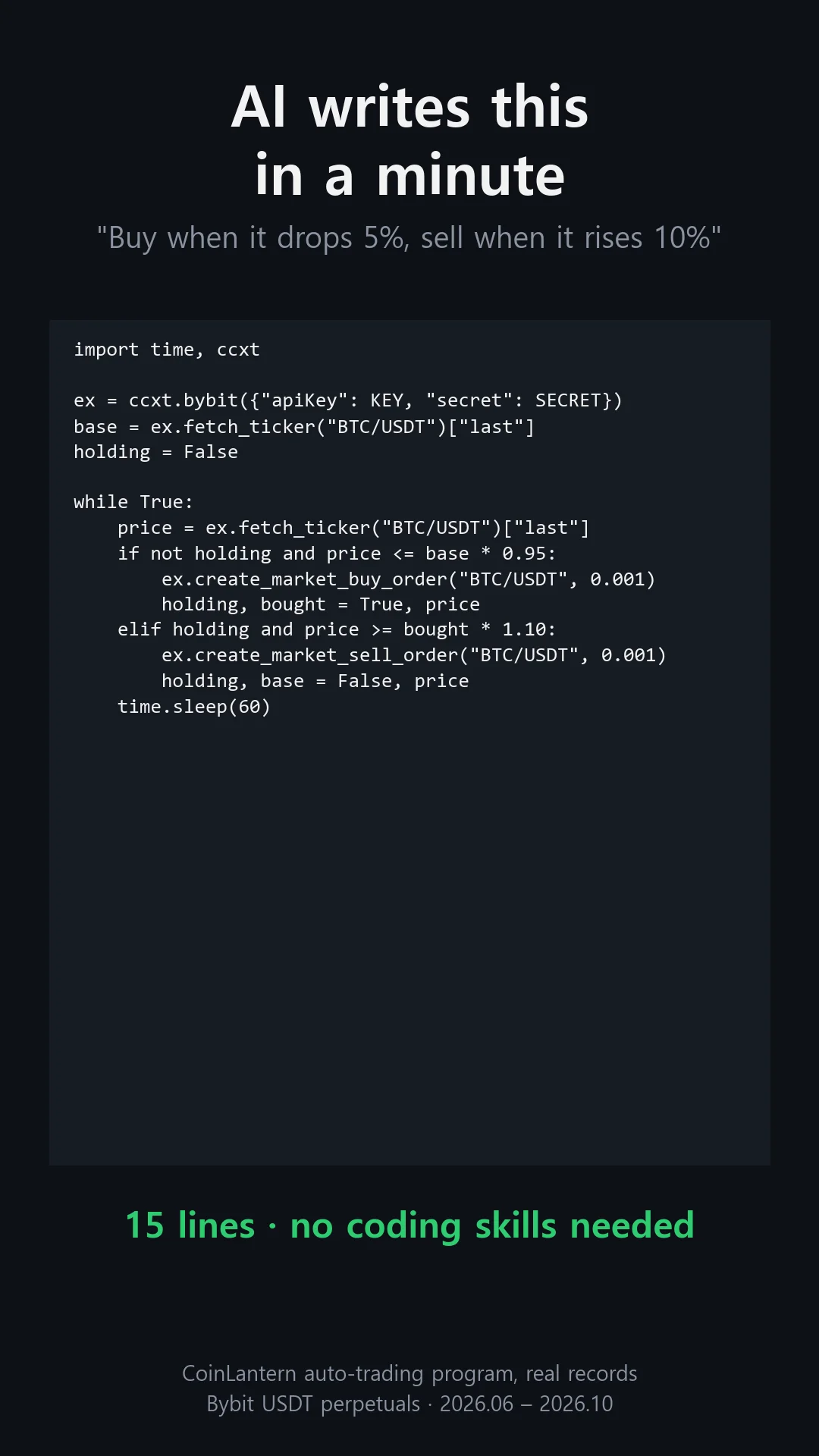
I wrote this one myself to illustrate the point, and I never ran it. Still, anyone can produce code like this today without knowing how to program. When I started, I assumed I'd add a strategy on top and be mostly done.
The real program runs to thousands of lines
Counting the lines in my current program makes the gap obvious.
| Part | Lines |
|---|---|
| Buy and sell (the example above) | 15 |
| 24/7 runtime (orders, accounts, positions, engine, server) | 8,308 |
| Strategies (including 395 experiment files) | 43,896 |

The 8,308 lines in the middle have nothing to do with strategy. They keep the program alive. They place orders, keep open positions in sync with the exchange, check account balances, and pick up open trades again after a restart. Right now 30 strategy setups run live across 12 accounts, so just tracking which account holds which coin is real work.
The 43,896 strategy lines are a bit inflated. I keep every experiment file, including the ones I tested and dropped. Read it as "this is how many strategies I built and tested" rather than "the strategy code is 44,000 lines."
Six things that actually happened
Once real money is involved, a small mistake turns straight into a loss or a halt. Here is what I ran into while the program was live.

On September 15, I had the live trading server running inside a preview window. When that window closed, the server went down with it. Nothing traded for 45 minutes. Since then the live server runs as a separate process that doesn't depend on any window.
On September 21, a restart caused trouble. After a restart, the program restores its open trades from the database. One strategy relied on a calculated value that was never saved there. With that value empty, the strategy failed every time it ran, and it sat stuck from 11:00 to 15:15, over four hours. Now it recalculates the value whenever it finds it empty.
In my first version, order size was the problem. Each coin has a fixed quantity step, so I rounded the size to fit it. A $5 order got rounded down below the exchange's minimum order value and was rejected. Switching from rounding to rounding up fixed it.
Leverage was similar. The maximum leverage differs from coin to coin, and when I sent an order above the limit, Bybit refused it with error 110013. Now, if that error comes back, the program lowers the leverage and tries once more.
On October 5, I found a data problem. The coin list I pulled from Bybit had stock futures mixed in. Things that weren't coins had ended up in my statistics, so the stats and simulations had to be recalculated.
On October 9, the program sent a short entry order on STG, a coin that was about to be delisted. Bybit rejected it, saying new positions can't be opened during delisting (error 30228).
Lost connections are something I always have to plan for, too. When the program can't get prices, it skips that 15-minute slot and tries again on the next one.
About 100,000 lines written and rewritten in four months
Fixing things one by one keeps the code changing. Adding up the Python lines added and deleted each day from June to early October gives about 100,000 lines (103,310).

The gray line is my first program: 42,200 lines written and changed from June through August. On September 11 I started rebuilding from scratch. That's the yellow line, which reached 61,100 lines in a little over a month. Over the same period I ran 505 strategy simulations.
Can you build one if you're not a developer?
I think you can. Today's AI will look at an error message, find the cause, and suggest a fix. If you're willing to put in the time and solve problems one at a time, it's a realistic project even without a programming background.
Just don't expect AI to hand you a finished system after a few clicks. Most of the problems above only showed up once real money was running through the program. If you decide to try, go in knowing you'll be clicking, fixing and rerunning far more than you expect.
Nothing here is investment advice. Crypto is volatile, and past results don't guarantee future returns.